PRETENTIOUS LATIN TITLE. DOWN TO EARTH POETRY, TEACHING & LEARNING

classic

Showing posts with label classic. Show all posts. The posts are listed in chronological order. Click the post title to read more.

Tuesday, 29 May 2012 in , , ,

I saw the best minds of my generation...

Allen Ginsberg reading “Howl” in Washington Square in 1966. Associated Press
'Howl' is quintessential. Quintessentially American. Quintessentially Beat. Quintessentially poetic. Fun fact: fellow poet Lawrence Ferlinghetti, of the famous Beat bookshop City Lights Books, was charged disseminating obscene literature after publishing Ginsberg's poem. In 1957, Judge Clayton W. Horn ruled that the book had 'redeeming social importance' and was thus not obscene. Thank god for that redeeming social importance, hey? Yet, in 2007, a planned broadcast of the poem was pulled for fears its content would see the station fined by the FCC. Yes, in 2007.

Did you also know that 'Howl' is now an amazing graphic novel by Eric Drooker?

 The mood and atmosphere of Drooker's artwork is perfect.
Copyright E. Drooker http://drooker.com/books/howl_pages.html
Buy Howl: the Graphic Novel by Eric Drooker at Fishpond.

Monday, 28 May 2012 in , , ,

Poetry and VoiceThread


VoiceThread is a cool little online application that lets you record via your computer's mic and upload the audio along with accompanying images, video and documents. It practically screams oral poetry recitation. Talk to the kids about poetry slams and then get them to upload a reading - of their own or someone else's work. Maybe someone would like to conquer Lewis Carrol's indomitable 'Jabberwocky':


`Twas brillig, and the slithy toves
  Did gyre and gimble in the wabe:
All mimsy were the borogoves,
  And the mome raths outgrabe.

"Beware the Jabberwock, my son!
  The jaws that bite, the claws that catch!
Beware the Jubjub bird, and shun
  The frumious Bandersnatch!"
He took his vorpal sword in hand:
  Long time the manxome foe he sought --
So rested he by the Tumtum tree,
  And stood awhile in thought.
And, as in uffish thought he stood,
  The Jabberwock, with eyes of flame,
Came whiffling through the tulgey wood,
  And burbled as it came!
One, two! One, two! And through and through
  The vorpal blade went snicker-snack!
He left it dead, and with its head
  He went galumphing back.
"And, has thou slain the Jabberwock?
  Come to my arms, my beamish boy!
O frabjous day! Callooh! Callay!'
  He chortled in his joy.


`Twas brillig, and the slithy toves
  Did gyre and gimble in the wabe;
All mimsy were the borogoves,
  And the mome raths outgrabe.

From Through the Looking Glass and What Alice Found There, 1872

Wednesday, 23 May 2012 in , , , , , ,

W.H. Auden, 'Musee Des Beaux Arts'

The Fall of Icarus, as depicted by artist Frank Wright.
Icarus. 1971. 15/16x5. Engraving.
http://www.gwu.edu/~fwright/graphics/icarus.html

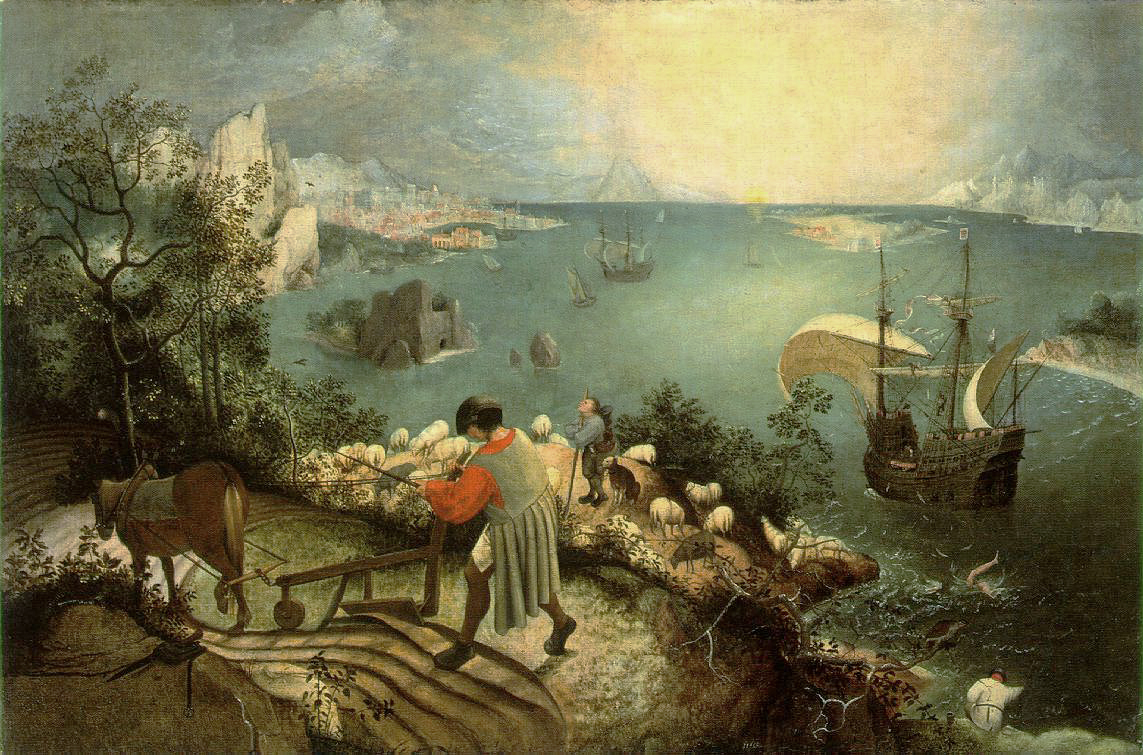
Most people have some knowledge of Greek mythology. It's almost impossible not to, what with everything from summer blockbusters to children's novels borrowing from the old stories. There are endless fun things to do tracking the development of those seminal stories over time, from Ovid's Metamorphoses to Percy Jackson. W. H. Auden wrote 'Musee Des Beaux Arts' in response Brueghel's Landscape with the Fall of Icarus, which is obviously about the Ovidian story of Icarus, the boy who flew too close to the sun. One day someone will do a musical based on the poem based on the painting based on the story, and then we'll really be cooking with gas.

Read Ovid's retelling of the myth of Icarus and Daedalus from Metamorphoses. Notice the juxtaposition between the everyday and extraordinary - this is Ovid's twist on the tale and the element Breughel focused on in his painting.

Both painting and poem are beautiful meditations on tragedy and the cyclical nature of human life.

Landscape with the Fall of Icarus. Held at the Royal Museum of Fine Arts of
Belgium. Fun Fact: the painting we know is in fact most probably a very good
copy of Brueghel's original, completed sometime in the 1560s.
Musee Des Beaux Arts
W. H. Auden

About suffering they were never wrong,
The Old Masters; how well, they understood
Its human 
position; how it takes place
While someone else is eating or opening a window or just walking dully along;
How, when the aged are reverently, passionately waiting
For the miraculous birth, there always must be
Children who did not specially want it to happen, skating
On a pond at the edge of the wood:
They never forgot
That even the dreadful martyrdom must run its course
Anyhow in a corner, some untidy spot
Where the dogs go on with their doggy life and the torturer's horse
Scratches its innocent behind on a tree.
In Breughel's Icarus, for instance: how everything turns away
Quite leisurely from the disaster; the ploughman may
Have heard the splash, the forsaken cry,
But for him it was not an important failure; the sun shone
As it had to on the white legs disappearing into the green
Water; and the expensive delicate ship that must have seen
Something amazing, a boy falling out of the sky,
had somewhere to get to and sailed calmly on.

Source: Another Time, 1940.